Thursday, April 12, 2018

Is Your Social Network Ready for the Big One? A Glimpse of Epicenter 2018

This week about 150 disaster preparedness professionals gathered in San Francisco's Presidio for Epicenter 2018, a conference on disaster preparedness hosted by the San Francisco Department of Emergency Services and the Salvation Army. Although, as the name implies, the main topic was preparing for the big shaker, there was also some valuable information passed along from lessons learned during the recent Wine Country wildfires and the tsunami at Fukushima. While it's impossible to summarize everything covered in two days, here are some interesting tidbits.

But first, a little background. Why are all of these disaster preparedness officials and nongovernment organizations (NGOs) gathering now?

Unfortunately..."You Are Here" on this fault map
California and, specifically, the San Francisco Bay Area is overdue for a 7+ quake on both the Hayward and San Andreas faults. Sandwiched between those faults are Marin County and San Francisco. Crossing those faults from east to west are most of the communications and infrastructure (freeways, power grids, water conduits) connecting these areas to the rest of the state. It's expected that when the big shaker comes, movement in the Hayward fault in particular will snap the communications and power lines crossing that fault and the resulting isolated Bay Area will be on its own. The term disaster preparedness folks in the Bay Area often use for this is "Haywired." (Get it? Literally the wires across this fault will not be able to take a slip and they'll just snap).

San Francisco has Invested to Get Ready
According to San Francisco Mayor Mark Farrell and City Administrator Naomi Kelly, who both spoke at the conference, the city has been preparing for this expected event every since Loma Prieta. "Our strategy has been taking small bites out of a big problem," said Kelly, who reported San Francisco has spent $11 billion in infrastructure including a new self-sufficient communications system to prepare itself. This was evident by the several mobile command posts and communications trucks on display in the parking lot outside of the event.

The Challenge in Los Angeles
According to Leslie Luke, the deputy director of the Los Angeles County Office of Emergency Management, Southern California is attempting to be equally prepared, but the challenges they face are even more monumental. Here are some of the considerations they are facing:

  • More than 2.7 million people will need to be fed in Los Angeles County after a large earthquake or similar disaster. That's 5.5 million meals a day.
  • More than 58,000 homeless people live in LA County on an ongoing basis. They'll need to be housed and fed as well.
  • More than 125,000 tourists are in LA County on any given day. They'll need to be cared for and sheltered with the rest of the population.
Carol Parks, community preparedness and engagement division chief for the City of Los Angeles Emergency Management Department, noted that 6 million people are in the LA area on any given day. These people rely on a network of mom and pop markets and 230 large grocery stores run by brand name chains. These stores are in turn supplied by 37 food distribution centers to the east. Her concern is that a major earthquake could knock out freeways and eliminate power needed to pump gas at gas stations therefore making it impossible for trucks to move food and other supplies from the distribution centers in the east into the Los Angeles Metro Area.

"Eighty percent of the problem (post a disaster) is trucks, drivers and gas," added Philip J. Palin, principal investigator for supply chain resilience at the Institute for Public Research.

Sometimes It's Who You Know, Not What You Know
Dr. Daniel Aldrich
Though there were many valuable presentations given on earthquake response from government authorities, one of the out of the box talks came from Dr. Daniel Aldrich, professor of political science, public policy and urban affairs for Northeastern University.

Dr. Alrich and his students have conducted massive surveys of the victims of Katrina and Fukushima to find and measure variables key to both survival and the desire by victims to return to an affected region and rebuild. What they found is that those in regions affected by storms, floods and tsunamis have different experiences based on their social network. In general, people that have a good network of friends and actually know their neighbors report less anxiety and improved mental health in general and, more important for a region's recovery, decide to return and rebuild.

Dr. Aldrich refers to neighbors as "Zero Responders." Because they are there even before first responders (i.e. firemen) and second responders (i.e. The Red Cross), they are the first to help neighbors dig themselves out of debris and find safety. Where do you find this "first line of defense" prior to an actual disaster taking place? Dr. Aldrich recommends attending community meetings, joining your PTA Board and generally getting to know the folks around you so when a disaster strikes, they are looking for you and concerned about your well being. Dr. Adrich noted that these community connections or, "horizontal connections" as he put it:
  • Saved lives during the Fukushima tsunami
  • Sped up recovery of neighborhoods after Katrina 
  • Improved the mental health of survivors in both situations.

Santa Rosa's McGlynn
Sean McGlynn, city manager for Santa Rosa, noted that this "neighbors helping neighbors" phenomenon was also a key factor during last year's wildfires in the wine country. "The community helped themselves," noted McGlynn. "If your neighbor didn't help you then it wasn't going to be a good end of story for you. He said this also helped the city begin to address recovery issues "almost from the beginning.

This was especially important for the piece of mind of those staffing the Emergency Operations Center as they balanced dealing with community needs and the needs of their own families. "Sixty-two of our employees lost their homes during the fires," noted McGlynn.

No Really...Get to Know Your Neighbors and Your Local Government
We've all seen the list of things you need to get ready for a big disaster like an earthquake. One gallon of water per day per person...check. Food you can consume without adding water or heat to prepare it...check. A battery operated radio with lots of spare batteries...check. A five-gallon bucket with liner bags and wipes you can use for personal sanitation...ewwww, but check. ...and the list goes on from there.

But, what came out of Epicenter 2018 and Dr. Aldrich's contribution to it was that, while supply chain resilience and the quick actions of first reponders are crucial, the connections between people that, as he put it, "bond, bridge and link" members of an affected community, are key to making it through something really big. Because, and I realize I'm stating the obvious, if cables across faults snap and bridges and freeways are either closed, flooded (hello Hwy 37) or congested, those bonds may become the most important in your life at a time when you need them the most.


Saturday, April 7, 2018

Active Shooter in a School: Statistics and Recommended Response


Note: As part of my duties for the American Red Cross, I've had the opportunity to join several disaster preparedness councils involving both government and non government organizations (NGOs). I've also had the opportunity to sit in on some very informative training sessions. Here's a recap of a four-hour Department of Homeland Security training that was offered through the Marin Sheriff's Office. The topic is timely, and, yes, a little scary if you are a parent like me: School Violence & the Active Shooter, taught by the Public Safety Training Institute.
On April 6, 2018, I attended a Homeland Security class at the Marin Sheriff's Office taught by the Public Safety Training Institute. The subject was what to do in an active shooter situation at a school and the attendees were deputies, policemen, firemen and educators. The class was four hours and taught by two former policemen with a combined 59 years on the job. One was a former SWAT commander. You may have seen the class covered on ABC Channel 7 News. While I won't try to duplicate all of the valuable information we received during this training, I will try to pass along a few bullets that might be of interest. 


Image Credit: Public Safety Training Institute


Goal: First responders on the scene of an active shooter in a school are taught to go after the shooter first to eliminate the threat, even before attempting to rescue and treat those who are injured. Their goal according to the instructor is "Not about saving everybody, but saving as many as we can."

Important facts:
 
  • Because active shooters are usually attempting to scare and harm as many as possible and do not care about escaping to commit another crime as a common thief would, for example, they are considered both criminals and terrorists. 
  • Most active shooter incidents last 12 minutes or less.
  • 60 percent of active shooters either commit suicide or die by "suicide by cop" by placing law enforcement in a position where they must shoot them.
  • Most school active shooter incidents happen in small or mid-sized communities.
  • 37 percent of incidents last less than 5 minutes. 60 percent of incidents last less than 7 minutes. 
  • 97 percent of active shooters are male.
  • 57 percent of incidents are over before law enforcement arrives.

 
Fire Alarms: Of special interest to the American Red Cross and firemen considering the greater safety issue is that many schools are creating policies to have students stay in lock down mode indoors even if a fire alarm is set off. This is because in 1998 at an Arkansas middle school and at subsequent incidents fire alarms were used by perpetrators to herd students and teachers outdoors to make them easier targets.
When school fire alarms can add to a dangerous situation.
In Arkansas, this was done by 11 and 13 year-old boys resulting in the death of five. So, the school staff have the tricky challenge of training how to respond and not torespond to fire alarms on campus.

There Are Warnings: FBI studies of incidents have concluded that most active shooters feel the need to post on social media (sometimes even pictures of themselves holding guns), make threats to others and talk about suicide. These are all warning signs to educators that a problem may be percolating on campus. The FBI has determined this after reviewing 220 incidents between 2000 and 2015. In those incidents,  661 were killed.
Florida School Shooter's disturbing social media post.
The message to educators is that the popular belief that the kids "just snap" isn't true. These incidents do not "occur out of the blue." There are warning signs and there is time to intervene. Privacy laws are not a barrier if there is a perceived threat to public safety, the instructors pointed out.

Frequency: The average number of active shooter incidents at schools has increased to an average of 20 per year over the past three years. This is up from an average of 7.

Run If You Can (and you know where the shooter is). Hide If You Can't. Fight as a Last Resort.
Image Credit: University of Pittsburgh

Recommended Response:
 
  1. Run (if there is a clear path and you know the active shooter is another area)
  2. Hide (lock down, barricade the door, turn off the HVAC, have kids under desks with cell phones off and cover windows if possible). Be invisible.
  3. Fight (as a last resort, fight with anything you can find if your barricade fails). 
    1. Weapons available in most classrooms are:
      1. Your classroom fire extinguisher, which can be used to blind and then as a blunt object to strike.
      2. Baseball bat
      3. Chairs
      4. Trash cans
      5. Flag poles (most have a pointed tip that makes them a viable spear. Desperate times call for desperate measures)


I know we all agree that we hope this never happens in Marin, but, like any other disaster, knowing a little about it and how best to respond will hopefully help us all be a little safer.


Tuesday, December 22, 2015

Kids These Days!!!

...are Awesome!

I know. I know. You thought I was going to say something about kids these days not giving or helping or working or something grandpa might say. Nope! What I saw yesterday was a group of high school students that pulled together and spent a day in pouring rain to collect food and deliver it to those in need.

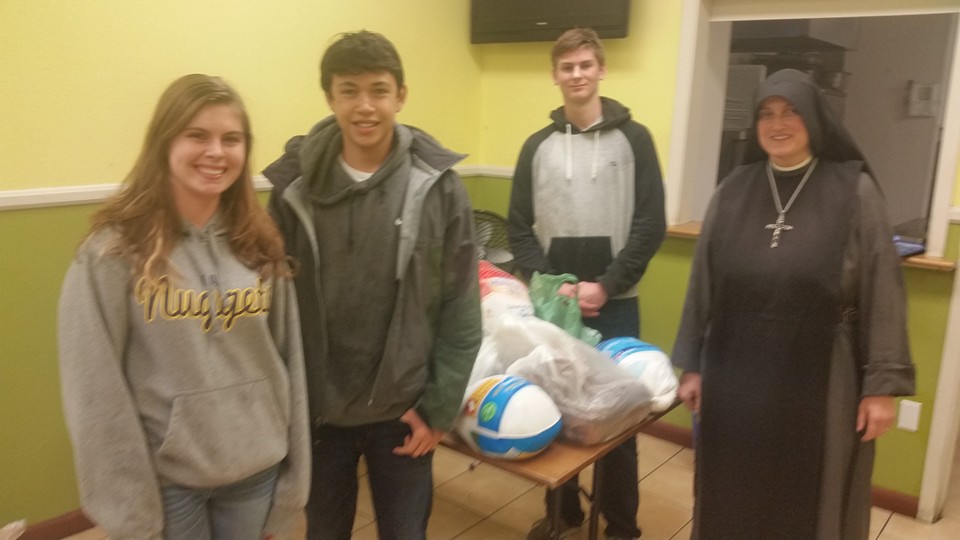
Garrett W., Nocole M., and Chadd A Were Part of Our Crew That Gathered More then 500 Pounds of Food

High School students from Novato High School and Marin Catholic High School participated in a food drive to collect turkeys, hams, pies, pasta, rice, potatoes, bread and other goodies in Marin County, California and bring an estimated 500-600 pounds of food to a soup kitchen in the Tenderloin. In partnership with San Francisco-based Food Runners, we did our best to adopt Fraternite Notre Dame and help them feed their neighborhood on Turk Street.

Fraternite Notre Dame is run by two Sisters who have a true dedication to service. They feed the neighborhood out of a small facility, clean up and then sleep there to rest up and do it all over again.

Some of Our High School Volunteers and Sister Marie Benedict with Part of the Food Donated to Fraternite Notre Dame.

With the help of some social media promotion from college student Lauren W. and some great Novato mothers (!!), our volunteers promoted the food drive, collected the food and then delivered it where it was needed the week of Christmas. Sure, there's an ice skating rink in Union Square and beautiful decorations in the shopping district, but in my humble opinion, going to the Tenderloin District and doing a little something to make Christmas better for others is a side of Christmas that should also be seen and experienced.

Merry Christmas! Happy Chanukah! We wish you the best in this coming new year!

Wednesday, December 9, 2015

Thanks to You Marin Catholic High School


We'd just like to take a moment to thank Marin Catholic High School for its support of our Tenderloin Turkey Drive for Fraternite Notre Dame. They are allowing us to distribute flyers and even use their parking lot as a donation pick up spot. (Details are on the flyer below.)

We are also receiving support from parents at Novato High School and are very appreciative of that. Our hope is that a Marin-based corporation will also take this on and we have reached out, but we don't want to put anyone in the spotlight until they feel it is a good fit for them.

Our crew of truck drivers, Sharon Miravalle, Nina McIsacc, Cassie Alciati, Lisa Winkler, Susan White are ready to come and pick up your donations on the 21st of December. 

Last week, we were at Fraternite Notre Dame on Turk Street in San Francisco's Tenderloin District and accidentally ran into our partners, Food Runners, who were also there to help. The facility is modest, full of heart and needs our support. This is a soup kitchen where those that serve hundreds of meals literally sleep in the kitchen to rest up and do it all over the next day. It is a privilege to help them with their mission this holiday season.

December 21st is the day. Buy a second turkey, fill a bag with canned cranberries and other goodies and bring it to one of our donation stations. Or, if you happen to be with a generous corporation or neighborhood that can pull together a donation in the bay area, we will send a truck to you.

Here's our homespun flyer:


Thursday, December 3, 2015

Let's Bring a Ton of Turkeys to the Tenderloin This Holiday Season!

No, really. We aren't kidding. Take a 20lb bird and multiply it by 100 and we'll have a ton of turkeys to make the holidays a little better for the Tenderloin. It's a goal we can make happen, but we need your help in the form of donated frozen turkeys, pies, canned cranberries and anything else that might make a holiday table more festive!

Though our current drop off spots are in Marin County, we will come to you and pick up a group donation if you work for a generous company in the San Francisco Bay Area. We're very pleased to partner with Food Runners of San Francisco and the Sisters at Fraternite Notre Dame to make this happen.

It's Time to Help. Be the difference!

Here are the details:


Wednesday, December 2, 2015

Tenderloin Turkey Drive


We're taking turkeys to the the Tenderloin. Actually, our goal is to take a ton of turkeys to the tenderloin (and canned cranberries, pies, candy and anything else that would add to a holiday table.) 

More info coming tomorrow. But, here's a preview. We've partnered with Food Runners of San Francisco and the Fraternite Notre Dame, which operates a soup kitchen in San Francisco's Tenderloin district that feeds 300 people a day and a lot more during the holidays. We are going to gather frozen turkeys and other holiday fixings and bring them into the Tenderloin so they can help feed those in need. 

High schoolers and Boy Scouts have offered to help get donations and load our truck/s so we are making this our holiday effort. 

Please stay tuned for more information on this. If you work for a generous corporation in the San Francisco Bay area and want to put together a donation, we'll send a truck to you and pick it up. Otherwise, we will have drop off places where you can bring a turkey or anything else that might be helpful and we'll make sure your items get where they are needed. Or, if you'd rather write a check and not lug around a frozen bird, you can send it to:

It's Time to Help
19 Aaron Drive
Novato, California  94949

and we'll purchase the turkey for you and send you a letter so you can let the IRS know just how nice you are. 

Remember, though I know we say this too often, but this time of year more than ever...

You Are The Difference.


Sunday, November 15, 2015

Just a Quick Note of Support to the French

We aren't equipped for international response at this time and are not a political organization in any stretch of the imagination. Just want to share a thought.

"France, our hearts are yours."